Bears vs. Packers: Give Swift Room and Bagent Time at Lambeau
Chicago’s preview centers on opening lanes for D’Andre Swift and Roschon Johnson while giving Tyson Bagent time to operate against Green Bay.
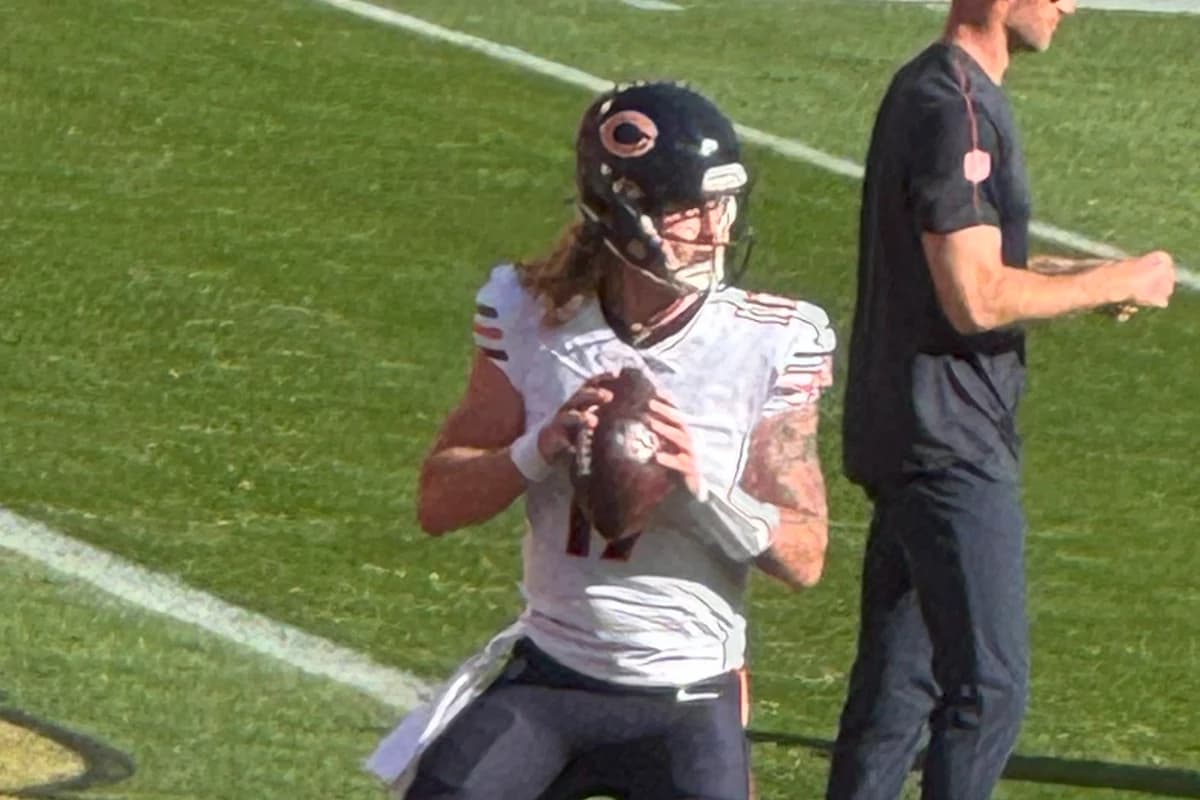
Archival photo, 2024-12-08. Before the Chicago Bears–San Francisco 49ers game at Levi's Stadium. Photo: ZappaOMatic, Wikimedia Commons. CC0 1.0. Cropped and resized.

Give Swift a crease, give  Bagent a chance
Swift should get to spend Sunday’s cuts on gaining yards, rather than auditioning as a backfield escape artist. Give him a path through the line and Bagent a moment to choose, and Chicago can make Green Bay defend the play it called. Let penetration wreck the handoff, and the quarterback’s next assignment becomes cleaning up the mess. The Bears’ best invitation to trouble would be asking both players to make something out of nothing.
Chicago visits Lambeau Field seeking a third straight victory overall and a 4-1 record. The October 11 kickoff is noon CT, moved from 3:25 p.m. CT. The opportunity deserves an offense with room to operate: blocking that preserves choices for Swift and Roschon Johnson, protection that lets Bagent use those choices, and touchdowns to show for the work.
Let Swift spend his cuts downfield
Monangai is out with the toe injury sustained against the  Jets. Swift practiced fully Friday and carries no injury designation into Sunday. Roschon moves into the No. 2 spot. That makes the line’s job especially consequential. Changing the back should not require changing the ambition of the offense.
Chicago leads the NFL with 196.3 rushing yards per game. Keeping the run productive would give Bagent more freedom over when and how to attack.
The Bears, etc. discussion argued that offensive-line performance deserves scrutiny before the runner when holes fail to open and the back must manufacture a gain. Applied to Chicago, the distinction is where the runner gets to make his decision. Blocking should let him approach the intended opening before penetration demands a detour. If Swift or Johnson can reach a crease without first avoiding penetration, Chicago could keep second down manageable.
One cut. Two different second downs.
Follow the back. Watch where his first decision happens.That would leave another handoff credible and give Bagent room to work through a passing call without needing it to recover lost ground. The value of a modest gain would extend into the next snap. An escape behind the line might look more impressive while leaving the offense with less.
Roschon’s opportunity should extend beyond spelling Swift. Ben Johnson praised his ability to run hard between the tackles. Johnson also identified his receiving and size in pass protection as assets. Those qualities suggest a way to preserve options through a substitution. A Roschon snap could support an inside run or help give Bagent time, without requiring the offense to narrow its intentions.
Ball security belongs in that calculation, too. Swift did not touch the ball again after losing a fumble midway through the third quarter against the Jets. A productive run that ends with possession surrendered cannot buy the quarterback anything.
Green Bay’s official preview framed its defensive objective as preventing Ben Johnson’s running game from controlling the contest and putting the burden on the backup quarterback. Chicago should make Green Bay earn that outcome one block at a time.
Give Bagent time, then use it
Ben Johnson announced that Bagent will start in Green Bay, while Caleb Williams is listed as questionable. There is no need to turn the passing plan into a holding pattern around that designation.
Against the Jets, Bagent completed 25 of 34 passes for 268 yards, directing an offense that produced a franchise-record 34 first downs, 492 total yards and 42:45 of possession. Bagent nevertheless said he passed up opportunities by moving to his checkdown too quickly. That admission sets a useful standard: efficient operation should still leave room for the intended throw.
Protection has to preserve that opportunity. Bagent then has to take it.
He described his preparation as banking repetitions, knowing the answers and executing the play as taught so teammates get their chance on time. The implication is a shared responsibility. Asking him to stay with a progression requires blocking that allows the progression to happen; providing that interval means little when the decision comes prematurely.
Green Bay’s coverage presents a separate complication. The Bears’ official preparation discussion praised the Packers’ safeties and nickel for disguising and rotating coverage, with the versatility to align in the box, post or half-field positions. Consequently, the first picture should not dictate an automatic answer. Protection would give Bagent time to reconcile the presentation with the coverage, rather than simply rush to the safest available completion.
The work begins before the snap. Bagent said Chicago was practicing silent cadence and emphasized loud communication under center and shared attention to the cadence in shotgun. A missed cue would spend the time the line is supposed to buy.
Thuney, Wright and Jonah Jackson are available without game designations. Parsons remains on PUP. Those availability details offer an opening for Chicago’s protection, but the payoff must be visible in Bagent’s decisions: enough time to reach the opportunity, followed by a throw that arrives when the play needs it.
Make Love work for the deep ball
Green Bay’s running numbers offer temptation. Bears, etc. reported the Packers averaging 58 rushing yards per game, last in the NFL. The show also cautioned against assuming a one-dimensional offense would make Love comfortable to defend, citing his downfield weapons and willingness to take chances.
Steering him toward passing is only useful when Chicago can disrupt the pass.
Love’s 113.2 career passer rating against the Bears is the highest among quarterbacks with at least 150 attempts against Chicago. In the Bears’ official preparation discussion, Love was assessed as especially dangerous throwing from a clean pocket with rhythm and timing. The defensive argument therefore starts with the clock inside the play: pressure must affect the release, and coverage must survive until it does.
Sweat against right tackle Anthony Belton is the identified matchup for generating pressure and limiting Green Bay’s explosive passing plays. That contest could determine whether Love gets to step into the downfield opportunities Chicago needs to deny.
Watson has 331 receiving yards and is one of four NFL receivers with at least 330 yards and three touchdowns. Golden has 274 receiving yards. Gordon and Turner have been downgraded to out. With those options unavailable, coordination between pressure and coverage becomes an especially important part of the matchup.
Chicago ranks second in third-down defense, allowing conversions at 23.7%. Getting Love into those situations would give that strength a chance to matter. A deep completion before third down would bypass it.
Finish the drive before it becomes an alibi
Ben Johnson said Chicago stressed finishing drives after two unsatisfactory weeks, then failed to correct the issue in the following game. He described problems that changed from week to week and emphasized sustained focus, clear calls and sound execution throughout long possessions.
Another afternoon of possession would need a better ending.
Chicago’s official preparation discussion identified play selection and motion timing among the varying execution issues. That points toward precision rather than a blanket demand for more aggression. A promising call still needs to arrive clearly, and its movement needs to happen at the intended moment.
The same discussion described moving the quarterback near the goal line as an option for addressing defensive numbers when a deep post safety is less likely. Movement could help preserve an answer as the space tightens. Its usefulness would depend on the offense carrying its timing all the way to the finish.
Sunday’s opportunity is to keep those choices alive from handoff to goal line. The measurable return should be manageable second downs becoming sustained drives, and sustained drives becoming touchdowns. Give Swift somewhere to go and Bagent time to choose, then make the final yards count.
Related reading
Story complete
You read the whole thing · 6 min read
Sources (10)
- Chicago BearsDennis Allen, Press Taylor, Richard Hightower prepare for Week 5 | Press ConferenceYouTube captions
Machine transcription may contain wording errors. Accuracy has not been independently measured.
- Chicago BearsBen Johnson discusses Mike Ditka's impact on Bears | Press ConferenceYouTube captions
Machine transcription may contain wording errors. Accuracy has not been independently measured.
- Chicago BearsTyson Bagent on preparing for Week 5 in Green Bay | Press ConferenceYouTube captions
Machine transcription may contain wording errors. Accuracy has not been independently measured.
- Chicago BearsFormer OL Jerry Fontenot talks Bears-Packers rivalry | Bears, etc. PodcastYouTube captions
Machine transcription may contain wording errors. Accuracy has not been independently measured.
- Green Bay PackersPackers Preview | CHIvsGBYouTube captions
Machine transcription may contain wording errors. Accuracy has not been independently measured.
- chicagobears.comRoster Moves: Chicago Bears activate Noah Sewell, elevate Zavier Scott
- chicagobears.comBears' Week 5 game vs. Packers moved to noon CT kickoff
- chicagobears.comInjury Update: Bears RB Kyle Monangai ruled out, QB Caleb Williams questionable for Packers game
- packers.comPackers list three questionable, two doubtful vs. Bears | Week 5 Injury Report
- chicagobears.comGame Preview: Bears at Packers | 2026 Week 5
Photo: Tyson Bagent by ZappaOMatic · CC0 · Cropped and resized.
Identifier: New York Jets · Public-domain text logo; trademark retained. Editorial identification, no endorsement.

Keep reading